I posted this on Facebook, but not all of us are on Facebook . . .
For all of us who have ever "shared" politically-themed links, or forwarded them via email, there is this timely reminder that we might be full of shit (Plus, see the Errol Morris Op-Doc link I posted not long ago [here]). May our resolutions for the New Year include endeavoring to attempt to try to strive to be less credulous, particularly when our egos & ideologies are involved!
--
Showing posts with label historical methods and philosophy. Show all posts
Showing posts with label historical methods and philosophy. Show all posts
Wednesday, November 23, 2011


Saturday, November 5, 2011
Perfectionism is just another form of procrastination
Last week I locked myself away in a cabin[1] in the woods in an area rumoured to lie within the range of Sasquatch. I did not see the Sasquatch[2], but I did get a lot of work done on the book, which I plan to report on soon.
I was chatting with a friend recently about the process of deciding upon and following-through with a research project. She's working on a thesis project for her Masters in English Language Learning, and I relayed to her some kernels of wisdom I've learned from my colleagues and mentors over the years:
----
[1] As you will see in the photos I will provide, it was quite a comfortable cabin. I'm eternally grateful to Michelle & family and Mary & family!!
[2] But maybe that was part of their plan . . . ?
--
I was chatting with a friend recently about the process of deciding upon and following-through with a research project. She's working on a thesis project for her Masters in English Language Learning, and I relayed to her some kernels of wisdom I've learned from my colleagues and mentors over the years:
- 1) Deciding upon a research topic is a conscious focus of will. One caveat:
- 1a) If one writes about the topic that one's advisor has chosen, and this topic does not correlate directly with one's own interests, the will will resist.
- 2) Any topic can be written about in 50 words, 500 words, 5,000 words, 500,000 words, or more; the skill is to figure out how to tailor the length and detail to the needs of one's audience and the purpose of the writing.
- 3) Calibrate #1 and #2 with the amount of time one has to devote to the project.
- 4) Just git 'er done. Two corollaries:
- 4a) Perfectionism is just another form of procrastination.
- 4b) All research is preliminary to some degree. Given the nature of academic research, there will always be both new sources to be found and other researchers who come along with new information and interpretations, so all analytical writing is to one extent or another, preliminary. But, we can't let that stop us.
----
[1] As you will see in the photos I will provide, it was quite a comfortable cabin. I'm eternally grateful to Michelle & family and Mary & family!!
[2] But maybe that was part of their plan . . . ?
--
Monday, October 17, 2011
A Graphic Post
I must warn you: This is a graphic post. Below the fold you will see images of line graphs and bar charts that provide visual representations of data across time. They look something like this:
If this seems like something that might cause your stomach to turn, perhaps you dare read no further; if, on the other hand, you have courage, stamina, and are sure that the kids won't be peeking over your shoulder, please do read on, because I'm seeking your input.
I would like any and all readers to weigh-in with comments and questions about the graphs below, and the conclusions I'm drawing from them, and to let me know if both of these are clear (or not). For those readers who have specialized training or experience in history, statistics, social science, mathematics, etc., I have some specific questions below that I would like help answering.
A common refrain I come across in both primary and secondary sources discussing the efforts and results of the Oregon State Sanitary Authority (OSSA) in addressing water pollution is that the Authority was not funded adequately. Authority members and historians have concluded that this lack of funding handicapped the OSSA between the time it commenced its work in early 1939 and the time that Governor Tom McCall restructured it and the Oregon Air Pollution Authority into the Oregon Department of Environmental Quality in 1969.
Perhaps the OSSA was underfunded, but that brings up at least two important points. First, it seems that the majority of government agencies, non-profits, for-profits, and individual households would prefer more money; I know I certainly would, and I also would prefer it if all of the non-profits that I support had much more funding. Therefore, it is quite common to hear complaints about a lack of money . . . but does that make it a pointless refrain, a case of "crying wolf?"
Second, is there some kind of objective reference point that one can call upon to gauge whether or not a given entity is "underfunded," "adequately funded," or "over-funded?" Maybe there are such metrics in some instances, but what might these be? In the case of the OSSA specifically, I suppose this metric would be whether or not the Authority was achieving it's legal mandate: Was the OSSA making substantive progress in abating water pollution? If not, to what extent does lack of progress correlate with a shortage of funds?
Asking these kinds of questions is important in a democracy. It's important for taxpayers to know where their money is going, and if the agency is using the money as effectively as possible. When voters turn-out overwhelmingly in favor of the creation of a new government agency -- as was the case with the OSSA in 1938 -- it's important for citizens to know that the agency is doing the work that they authorized it to do. Of course, there is at least one important dynamic that confounds this straightforward logic: Are citizens willing to pay for achieving the purported goal of a given piece of legislation or citizen's initiative?
The pattern of my pursuit of these answers regarding the OSSA can just as easily be applied to other local, state, or federal government agencies.
The first graph I want to show you is straightforward:
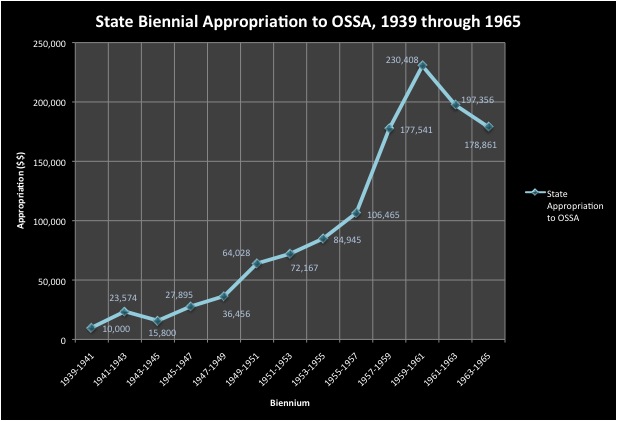 |
| Image 1: Oregon State Biennial Appropriation to the OSSA, 1939 through 1965. |
If this seems like something that might cause your stomach to turn, perhaps you dare read no further; if, on the other hand, you have courage, stamina, and are sure that the kids won't be peeking over your shoulder, please do read on, because I'm seeking your input.
I would like any and all readers to weigh-in with comments and questions about the graphs below, and the conclusions I'm drawing from them, and to let me know if both of these are clear (or not). For those readers who have specialized training or experience in history, statistics, social science, mathematics, etc., I have some specific questions below that I would like help answering.
A common refrain I come across in both primary and secondary sources discussing the efforts and results of the Oregon State Sanitary Authority (OSSA) in addressing water pollution is that the Authority was not funded adequately. Authority members and historians have concluded that this lack of funding handicapped the OSSA between the time it commenced its work in early 1939 and the time that Governor Tom McCall restructured it and the Oregon Air Pollution Authority into the Oregon Department of Environmental Quality in 1969.
Perhaps the OSSA was underfunded, but that brings up at least two important points. First, it seems that the majority of government agencies, non-profits, for-profits, and individual households would prefer more money; I know I certainly would, and I also would prefer it if all of the non-profits that I support had much more funding. Therefore, it is quite common to hear complaints about a lack of money . . . but does that make it a pointless refrain, a case of "crying wolf?"
Second, is there some kind of objective reference point that one can call upon to gauge whether or not a given entity is "underfunded," "adequately funded," or "over-funded?" Maybe there are such metrics in some instances, but what might these be? In the case of the OSSA specifically, I suppose this metric would be whether or not the Authority was achieving it's legal mandate: Was the OSSA making substantive progress in abating water pollution? If not, to what extent does lack of progress correlate with a shortage of funds?
Asking these kinds of questions is important in a democracy. It's important for taxpayers to know where their money is going, and if the agency is using the money as effectively as possible. When voters turn-out overwhelmingly in favor of the creation of a new government agency -- as was the case with the OSSA in 1938 -- it's important for citizens to know that the agency is doing the work that they authorized it to do. Of course, there is at least one important dynamic that confounds this straightforward logic: Are citizens willing to pay for achieving the purported goal of a given piece of legislation or citizen's initiative?
The pattern of my pursuit of these answers regarding the OSSA can just as easily be applied to other local, state, or federal government agencies.
The first graph I want to show you is straightforward:
Thursday, September 1, 2011
Does history teaching matter?
At the suggestion of a friend, I've recently become more involved with the social networking site Linkedin. Thus far, I certainly prefer Linkedin to Facebook because the former is focused on professional networking.
As part of this involvement, I joined a few Linkedin discussion groups, including one moderated by the American Historical Association. Mike Maxwell asked in a recent thread: "Does history teaching matter?"
"Yes," I replied, and by that I of course meant ". . . but with some caveats . . ."
As part of this involvement, I joined a few Linkedin discussion groups, including one moderated by the American Historical Association. Mike Maxwell asked in a recent thread: "Does history teaching matter?"
"Yes," I replied, and by that I of course meant ". . . but with some caveats . . ."
Thursday, July 28, 2011
Tuesday, July 12, 2011
Book Project Update: Running to Stand Still
I've recently started a writing group with a few local colleagues (and Northwest History Network members). We're calling ourselves writeordiepdx. We're just starting to get rolling. In reply to one of my colleague's status reports, I wrote the following:
Saturday, June 4, 2011
Another example of the difference between an "historian" and an Historian
So, I'm in the process of writing a series of concise Oregon Encyclopedia articles on some U.S. Navy ships that had Oregon-based names. One of the entries is on the U.S.S. Oregon City (CA-122). This isn't brain surgery that I'm doing here -- writing informative and authoritative 250-500 word entries on U.S. Navy ships isn't all that complicated.[1] With this and other such entries, I have, of course, consulted the most essential sources[2], but I also wanted to include in my entries some truly Oregon-specific information.
Among other things I've done is to consult various articles in the Oregonian, as I've been able to find them. In this search for documentation to bring new and intriguing information to readers, I've experienced some frustration that speaks directly to the frustrations I've had with so-called "historians," and am now in a position to articulate the essence of this frustration.
What we have here is another example of the difference between amateur and professional -- or, the difference between someone who's not conscious of what she or his is doing and why he or she is doing it, and someone who is.
In this particular instance, it's one of those things that seems obvious in hindsight but makes all the difference in the world.
Among other things I've done is to consult various articles in the Oregonian, as I've been able to find them. In this search for documentation to bring new and intriguing information to readers, I've experienced some frustration that speaks directly to the frustrations I've had with so-called "historians," and am now in a position to articulate the essence of this frustration.
What we have here is another example of the difference between amateur and professional -- or, the difference between someone who's not conscious of what she or his is doing and why he or she is doing it, and someone who is.
In this particular instance, it's one of those things that seems obvious in hindsight but makes all the difference in the world.
Monday, April 25, 2011
On "The Tragedy of the Commons" (again)
A few weeks ago, I made the claim that I was done thinking about Garrett Hardin's "tragedy of the commons" metaphor.
Apparently I was wrong.
I attended the 2011 ASEH conference in Phoenix a few days ago and had two important and distinct opportunities to learn more about the weaknesses of Hardin's commons metaphor. In spite of my claim that I was done thinking about this, I came away from the conference with new information that should serve as my final, final statement on the topic.
Apparently I was wrong.
I attended the 2011 ASEH conference in Phoenix a few days ago and had two important and distinct opportunities to learn more about the weaknesses of Hardin's commons metaphor. In spite of my claim that I was done thinking about this, I came away from the conference with new information that should serve as my final, final statement on the topic.
This video clearly wasn't meant for my viewing
This video clearly wasn't made for my benefit, but a loved one forwarded it to me and we got a good chuckle out of it. What entertained us the most was the opening narration--and by "entertained" I mean I found it cringe-worthy to the extent that I just had to laugh before I pulled the rest of my hair out.
The video illustrates some classic examples of specious arguments and logical fallacies, and because the narration includes the word "history" I just couldn't pass up the opportunity to respond to my loyal reader.[1]
Read my analysis of the narration below the fold, and let me know what you think, but be forewarned: it's about religion . . .
 |
| Bald Me. |
The video illustrates some classic examples of specious arguments and logical fallacies, and because the narration includes the word "history" I just couldn't pass up the opportunity to respond to my loyal reader.[1]
Read my analysis of the narration below the fold, and let me know what you think, but be forewarned: it's about religion . . .
Monday, March 21, 2011
Raw excrement vs. medieval combat

From late November 2010 into January 2011 I was quite fixated on playing the game Mount & Blade: Warband. I had been waiting for this game for about twenty years. Though set in the fictional realm of "Calradia," the game strives to emulate Medieval Europe & European kingdoms, sultinates, fiefdoms, etc. At the strategic level of the game, one engages in negotiations and trade and agrees to complete tasks for village elders, town leaders, and various political factions. On the tactical level, one wields a weapon of choice to hack away at and sling arrows at enemy foot soldiers and horsemen. The goal, of course, is to conquer, vanquish, overwhelm, and otherwise find a way to found a kingdom of one's own.
Absent at every level of this game is magic, fantasy, dragons, potions, dwarves, and all of that nonsense.
Very exciting & fun stuff!!!
I will leave it up to readers to evaluate the extent to which my interest in this game provides evidence of patriarchy, warmongering, meaningless game-playing, escapism, moral turpitude, existential shallowness, Generation-X Peter Panism, etc., etc.
What is fascinating to me is
My final thought about "the commons" . . .
(. . . at least in terms of applicability of the metaphor to my book project.)
As part of the process of trying to clarify the topic for my own benefit, I've written three posts analyzing Garrett Hardin's "tragedy of the commons" metaphor (here, here, and here). I've finally read & digested John A. Baden and Douglas S. Noonan, eds., Managing the Commons (2nd ed., Bloomington: Indiana University Press, 1998) and now know how I'm going to address this metaphor in my book.
As part of the process of trying to clarify the topic for my own benefit, I've written three posts analyzing Garrett Hardin's "tragedy of the commons" metaphor (here, here, and here). I've finally read & digested John A. Baden and Douglas S. Noonan, eds., Managing the Commons (2nd ed., Bloomington: Indiana University Press, 1998) and now know how I'm going to address this metaphor in my book.
Tuesday, March 15, 2011
The difference between amateur and professional

As the photo above indicates, sure, I can build something out of wood that's more-or-less functional and, if given a sufficient amount of paint, I can even succeed in hiding some of the more egregious blemishes on what I build.[1]
Contrast this with what a professional custom cabinet and furniture maker can do:
Tuesday, March 8, 2011
Is not being stupid not enough?
There is a fascinating discussion over at Intellectual History "How Should Intellectual Historians Deal with Erroneous, Foolish, or Vicious Thought?" As Ben writes in the post, historians generally don't have a problem taking seriously egregiously wrong[1] ideas from the past and applying a more detached and objective approach to these ideas in order to establish their context, learn more about their adherents, and investigate their causes and effects.
However, what is the historian's role in shedding light on egregiously wrong ideas in the present?
In his brief post, Ben provides three things to think about as historians work to identify or otherwise confront wrong ideas in the present:
I also have a long list of posts-in-process that I may never finish but that share the theme of "what the f#*k?!?!?! Do (Glenn Beck/Sarah Palin/Newt Gingrich/insert your favorite blowhard here) actually believe what they're spewing, or are they blatantly & cynically manipulating the historical record on purpose?"
I like what Tim Lacy has to say in response to Ben's post, as it's relevant to the question I continue to reflect upon -- namely "what is history?":
[1] By "wrong" Ben seems to be suggesting both ideas that are "deeply incorrect" in an objective sense (an example from my own area of study would be the miasmatic theory of disease etiology) and ideas that are wrong in a moral sense (i.e., slavery).
-
However, what is the historian's role in shedding light on egregiously wrong ideas in the present?
In his brief post, Ben provides three things to think about as historians work to identify or otherwise confront wrong ideas in the present:
- 1) "People do express opinions about the past that are simply wrong. And as historians, we have a responsibility, perhaps even a duty, to point out when people use bad history to bolster their arguments in public debate."
- 2) "significant ideas that we happen to believe are wrong, inane, or even deeply evil should still be taken seriously."
- 3) "Of course how we do this . . . is a more complicated question."
I also have a long list of posts-in-process that I may never finish but that share the theme of "what the f#*k?!?!?! Do (Glenn Beck/Sarah Palin/Newt Gingrich/insert your favorite blowhard here) actually believe what they're spewing, or are they blatantly & cynically manipulating the historical record on purpose?"
I like what Tim Lacy has to say in response to Ben's post, as it's relevant to the question I continue to reflect upon -- namely "what is history?":
- Our job is to help tease through the hierarchy of causes and sort out the probability of relevance. We're experts on the probability of relevance.
[1] By "wrong" Ben seems to be suggesting both ideas that are "deeply incorrect" in an objective sense (an example from my own area of study would be the miasmatic theory of disease etiology) and ideas that are wrong in a moral sense (i.e., slavery).
-
Monday, March 7, 2011
A reflection on the historical method
I recently received a comment in this post that included the following thought-provoking points:
- do you think that historians provide “pure” interpretations of history, and if so, what is meant by a “pure” interpretation?? Here’s my take on history: the event happens, multiple people try to “interpret” it and write it down, then more people (historians) “interpret” the interpretations until we are left with something that may not resemble the original at all . . . I’m not suggesting that historians commit malfeasance on purpose; I’m only saying that each of them (including you) interprets history through [a] unique lens. Who is to say, after all, that even at the moment of action the historical event can be reported purely? This is what makes history (and communication) rich! The fact that there can be, and are, multiple interpretations based on who is receiving the information.
Tuesday, March 1, 2011
"Ugh! Harumph!!"

I've recently had some experiences that, to me, illustrate a fascinating discrepancy between what people express and how other people perceive these expressions. These experiences have got me reflecting on how amazing it is that humans can even communicate on anything more than the most basic levels (i.e., "need food now," "want sex now," "you go away now," "you come here now," "no," "yes," etc., like some stereotyped cave-dwelling hominid).
Tuesday, February 22, 2011
My book project
I neglected to inform the blog universe* back in December that the Oregon State University Press has decided to offer me a preliminary contract for my book on Willamette River pollution. This contract hinges upon completion of my manuscript on or before Oct. 1, 2011, and positive scholarly review of the manuscript.
Yaaaaayyyyy!!!!
In climbing the figurative mountain, I've reached a plateau.
Yaaaaayyyyy!!!!
In climbing the figurative mountain, I've reached a plateau.
Monday, February 14, 2011
Atheism or Agnosticism? That is the question
Uh-oh, time to get deep and contentious!
Don't read this post if you're not ready to think about that sticky R-word, religion. If you're easily offended or firmly ensconced in a fundamentalism, this is not the post for you; go read something light, fluffy, and meaningless like this.

Still with me? Ok, you've been warned . . .
Don't read this post if you're not ready to think about that sticky R-word, religion. If you're easily offended or firmly ensconced in a fundamentalism, this is not the post for you; go read something light, fluffy, and meaningless like this.
Still with me? Ok, you've been warned . . .
Friday, January 21, 2011
Where to draw the line?
A few months ago, I heard from my bosses in the PSU University Studies Dept. that the Capstone course I have taught now for nine consecutive quarters would come to an end after the Spring 2011 quarter. I was told that the School of Business Administration, under which my Capstone was administered, was reacting to budget reductions by cutting or incorporating within the department 20% of their Capstones, and that my course would likely be on the chopping block.
C'est la vie. Time to make lemonade. Etc.
So, since I heard this news I've been looking for work. I've been looking at a variety of positions that will enable me to apply my expertise in urban environmental history outside of academia. I've applied to a few positions where I would be working with teams engaged in one aspect or another of the Portland Harbor Superfund Cleanup process.
I recently came across a Portland Business Journal article "Attorneys vie for Superfund work," where I read that "Attorneys are lining up to snag their share of Superfund work along the Portland Harbor."
"A-ha!" I thought, "Perhaps I'll see if I can get on with one of these firms, since the Superfund cleanup process is sure to be complex and long-term, and, of course, whomever is working on it will benefit from insights of an historian."
Slam-dunk for me, eh?
There were a number of specific legal firms identified in the Portland Business Journal article, so I navigated to their websites and started to poke around. Then I saw lists of some of their current and past clients. I read on one website that the firm had "Defended salmon aquaculture industry in appeals of waste discharge permits by environmental groups." Another firm expressed a feeling of privilege "to serve market leaders that have been driving forces in their industries."
Uh-oh.
C'est la vie. Time to make lemonade. Etc.
So, since I heard this news I've been looking for work. I've been looking at a variety of positions that will enable me to apply my expertise in urban environmental history outside of academia. I've applied to a few positions where I would be working with teams engaged in one aspect or another of the Portland Harbor Superfund Cleanup process.
I recently came across a Portland Business Journal article "Attorneys vie for Superfund work," where I read that "Attorneys are lining up to snag their share of Superfund work along the Portland Harbor."
"A-ha!" I thought, "Perhaps I'll see if I can get on with one of these firms, since the Superfund cleanup process is sure to be complex and long-term, and, of course, whomever is working on it will benefit from insights of an historian."
Slam-dunk for me, eh?
There were a number of specific legal firms identified in the Portland Business Journal article, so I navigated to their websites and started to poke around. Then I saw lists of some of their current and past clients. I read on one website that the firm had "Defended salmon aquaculture industry in appeals of waste discharge permits by environmental groups." Another firm expressed a feeling of privilege "to serve market leaders that have been driving forces in their industries."
Uh-oh.
Wednesday, January 12, 2011
Peer attentively into the bubbles . . .
History and statistics are both fun and educational!
Dr. Hans Rosling has also presented at a TED conference:
Dr. Hans Rosling has also presented at a TED conference:
Saturday, November 13, 2010
Noteworthy website: Seattle Civil Rights & Labor History Project
We at the Northwest History Network recently featured historians Trevor Griffey and Felicia Williams and union leader Keith Edwards at our quarterly public event. The event provided some comparisons-&-contrasts between Portland's and Seattle's labor and civil rights history in the second half of the twentieth century.
Trevor is a Seattle-based historian, finishing his PhD at the University of Washington. He co-edited a recently-published book, Black Power at Work, and he serves as the Project Coordinator of a highly informative website, the Seattle Civil Rights & Labor History Project (SCRLHP).
The SCRLHP contributes to our knowledge in the following ways:
Trevor is a Seattle-based historian, finishing his PhD at the University of Washington. He co-edited a recently-published book, Black Power at Work, and he serves as the Project Coordinator of a highly informative website, the Seattle Civil Rights & Labor History Project (SCRLHP).
The SCRLHP contributes to our knowledge in the following ways:
Subscribe to:
Posts (Atom)