Thursday, October 27, 2011


Sunday, October 23, 2011
Craft brews at WalMart (and somewhat related news)
Laura Gunderson reported in the Oct. 21, 2011, Oregonian that "Former Walmart exec says the retailer plans on more craft beers."
First organic food, and now craft beer: It seems as though social pressures & gradual societal changes are incrementally influencing the ubiquitous behemoth that is WalMart.
This is good news, but does this mean that those of us who purposely avoid WalMart should start shopping there? Do these kinds of changes make-up for their lamentable relationship with organized labor?
Gunderson's article also mentions that 7-Eleven has contracted with City Brewery of La Crosse, Wisconsin, to produce a 7-Eleven house brew. I haven't had it yet, but it certainly seems an interesting idea.
On a somewhat related note, I just poked around the Internet a bit and found that the Gordon Biersch Brewing Company of Palo Alto, California, contract-brews beer for both Trader Joe's and Costco. I've tried and enjoyed the Trader Joe's-labeled beers, but haven't had the Costco beers yet.
--
First organic food, and now craft beer: It seems as though social pressures & gradual societal changes are incrementally influencing the ubiquitous behemoth that is WalMart.
This is good news, but does this mean that those of us who purposely avoid WalMart should start shopping there? Do these kinds of changes make-up for their lamentable relationship with organized labor?
Gunderson's article also mentions that 7-Eleven has contracted with City Brewery of La Crosse, Wisconsin, to produce a 7-Eleven house brew. I haven't had it yet, but it certainly seems an interesting idea.
On a somewhat related note, I just poked around the Internet a bit and found that the Gordon Biersch Brewing Company of Palo Alto, California, contract-brews beer for both Trader Joe's and Costco. I've tried and enjoyed the Trader Joe's-labeled beers, but haven't had the Costco beers yet.
--
Tuesday, October 18, 2011
My friend was recently in the news -- and for all the right reasons!
 |
| PSU Engineering Graduate Student Seth Moody: Not a Miscreant. Oct. 2011. |
One day a few years ago, I ran an Internet search on my own name* and came across a report of a James Hillegas in Pennsylvania who had been accused of killing his parents, or was involved in a hit-and-run, or something similarly nefarious. I knew it couldn't have been me because they showed a picture of the guy, and while he was also a cracker, he was at least 15 years younger and not balding; plus, I don't recall being in Pennsylvania at the time. I concluded, therefore, that there was at least one other James Hillegas in the world, making headlines for all the wrong reasons.
This brings me to the topic of this post: OPB's Rob Manning recently featured a project in Haiti that my dear friend Seth Moody is involved with -- "Can 'Green' Construction Product Hold Up In Haiti's Humid Climate?" There certainly may be other Seth Moodys in the world, some of whom may be doing nefarious things, but my friend Seth made the news for all the right reasons, I'm happy to report.
Seth is involved in a project to help Haitians recover from the devastating earthquake of 2010. As part of this project, he and his colleagues also ran tests on a particular building material that was slated for use in Haiti. They found the material lacking in structural integrity when it got wet.
The manufacturer continues to refine the material, and hopefully they'll come up with an improved version.
I appreciate the motivation and foresight of Seth and his colleagues to help improve this product. The worse thing in this case would be to foist upon the long-suffering people of Haiti a woefully inadequate and frighteningly unsafe product.
----
[*] Yeah, there's a bit of vanity involved, but, come on . . . you can't tell me you haven't done it before!
--
Monday, October 17, 2011
A Graphic Post
I must warn you: This is a graphic post. Below the fold you will see images of line graphs and bar charts that provide visual representations of data across time. They look something like this:
If this seems like something that might cause your stomach to turn, perhaps you dare read no further; if, on the other hand, you have courage, stamina, and are sure that the kids won't be peeking over your shoulder, please do read on, because I'm seeking your input.
I would like any and all readers to weigh-in with comments and questions about the graphs below, and the conclusions I'm drawing from them, and to let me know if both of these are clear (or not). For those readers who have specialized training or experience in history, statistics, social science, mathematics, etc., I have some specific questions below that I would like help answering.
A common refrain I come across in both primary and secondary sources discussing the efforts and results of the Oregon State Sanitary Authority (OSSA) in addressing water pollution is that the Authority was not funded adequately. Authority members and historians have concluded that this lack of funding handicapped the OSSA between the time it commenced its work in early 1939 and the time that Governor Tom McCall restructured it and the Oregon Air Pollution Authority into the Oregon Department of Environmental Quality in 1969.
Perhaps the OSSA was underfunded, but that brings up at least two important points. First, it seems that the majority of government agencies, non-profits, for-profits, and individual households would prefer more money; I know I certainly would, and I also would prefer it if all of the non-profits that I support had much more funding. Therefore, it is quite common to hear complaints about a lack of money . . . but does that make it a pointless refrain, a case of "crying wolf?"
Second, is there some kind of objective reference point that one can call upon to gauge whether or not a given entity is "underfunded," "adequately funded," or "over-funded?" Maybe there are such metrics in some instances, but what might these be? In the case of the OSSA specifically, I suppose this metric would be whether or not the Authority was achieving it's legal mandate: Was the OSSA making substantive progress in abating water pollution? If not, to what extent does lack of progress correlate with a shortage of funds?
Asking these kinds of questions is important in a democracy. It's important for taxpayers to know where their money is going, and if the agency is using the money as effectively as possible. When voters turn-out overwhelmingly in favor of the creation of a new government agency -- as was the case with the OSSA in 1938 -- it's important for citizens to know that the agency is doing the work that they authorized it to do. Of course, there is at least one important dynamic that confounds this straightforward logic: Are citizens willing to pay for achieving the purported goal of a given piece of legislation or citizen's initiative?
The pattern of my pursuit of these answers regarding the OSSA can just as easily be applied to other local, state, or federal government agencies.
The first graph I want to show you is straightforward:
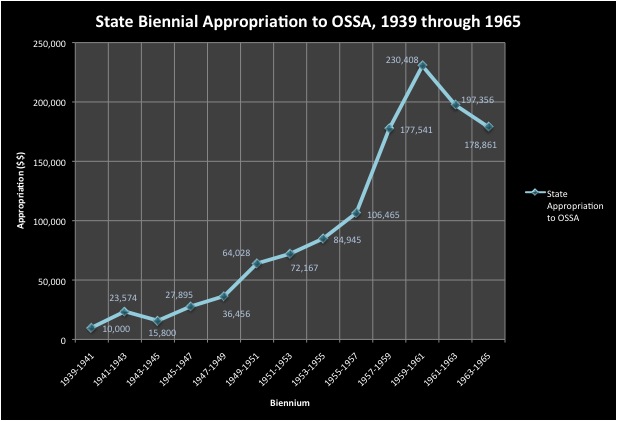 |
| Image 1: Oregon State Biennial Appropriation to the OSSA, 1939 through 1965. |
If this seems like something that might cause your stomach to turn, perhaps you dare read no further; if, on the other hand, you have courage, stamina, and are sure that the kids won't be peeking over your shoulder, please do read on, because I'm seeking your input.
I would like any and all readers to weigh-in with comments and questions about the graphs below, and the conclusions I'm drawing from them, and to let me know if both of these are clear (or not). For those readers who have specialized training or experience in history, statistics, social science, mathematics, etc., I have some specific questions below that I would like help answering.
A common refrain I come across in both primary and secondary sources discussing the efforts and results of the Oregon State Sanitary Authority (OSSA) in addressing water pollution is that the Authority was not funded adequately. Authority members and historians have concluded that this lack of funding handicapped the OSSA between the time it commenced its work in early 1939 and the time that Governor Tom McCall restructured it and the Oregon Air Pollution Authority into the Oregon Department of Environmental Quality in 1969.
Perhaps the OSSA was underfunded, but that brings up at least two important points. First, it seems that the majority of government agencies, non-profits, for-profits, and individual households would prefer more money; I know I certainly would, and I also would prefer it if all of the non-profits that I support had much more funding. Therefore, it is quite common to hear complaints about a lack of money . . . but does that make it a pointless refrain, a case of "crying wolf?"
Second, is there some kind of objective reference point that one can call upon to gauge whether or not a given entity is "underfunded," "adequately funded," or "over-funded?" Maybe there are such metrics in some instances, but what might these be? In the case of the OSSA specifically, I suppose this metric would be whether or not the Authority was achieving it's legal mandate: Was the OSSA making substantive progress in abating water pollution? If not, to what extent does lack of progress correlate with a shortage of funds?
Asking these kinds of questions is important in a democracy. It's important for taxpayers to know where their money is going, and if the agency is using the money as effectively as possible. When voters turn-out overwhelmingly in favor of the creation of a new government agency -- as was the case with the OSSA in 1938 -- it's important for citizens to know that the agency is doing the work that they authorized it to do. Of course, there is at least one important dynamic that confounds this straightforward logic: Are citizens willing to pay for achieving the purported goal of a given piece of legislation or citizen's initiative?
The pattern of my pursuit of these answers regarding the OSSA can just as easily be applied to other local, state, or federal government agencies.
The first graph I want to show you is straightforward:
Monday, October 10, 2011
Liberty Ships, Including Festering Liberty Ship Hulls on the Columbia River
 |
| Response teams try to contain fuel spilled into the Columbia River by the Davy Crockett, a derelict barge that split open in late January 2011 near Camas, Wash., after a scrap operation went awry. Bruce Ely, The Oregonian |
I recently wrote an Oregon Encyclopedia entry on the Liberty Ship Star of Oregon, which was the first Liberty Ship that Henry Kaiser's Oregon Shipbuilding Corporation ("Oregon Ship") built.[1] Workers laid its keel in May 1941, launched the ship on September 27, 1941 ("Liberty Fleet Day"), and Oregon Ship delivered it to the U.S. Maritime Commission on December 31, 1941.
The Star of Oregon was the first Liberty Ship launched on the West coast, the second Liberty Ship launched nationally, and either the first or the second Liberty Ship actually delivered for service (my sources differ on this, and I'm still trying to figure it out).
I'm telling you all this because I have Liberty Ships on my mind of late, and then I read about a festering hulk of rotten metal corroding away on the Columbia River at Camas, Washington, and I thought you might like to know a bit more . . .
Saturday, October 8, 2011
DIY History Detective: A Quest in the Wilds of St. Johns
I recently took a fun ride into the wilds of industrial far-northwest St. Johns on a brave quest to see if I could locate a building that was part of the Oregon Shipbuilding Corporation's ("Oregon Ship") administrative headquarters during World War II, and later served as the location of Portland State University's precursor institution, Vanport Extension Center.
Why would I do such a thing?
I was curious about this building because I had read in a May 1943 Oregonian article that the Oregon Trail Centennial Commission had re-dedicated a plaque on one of these buildings to commemorate the 100th anniversary of the launch of the first ship that European Americans had built in Oregon, the schooner Star of Oregon. [1]
I was curious to know if this building still existed and, if it did, if the plaque might still be on the building.
The short answer to both of these questions is "no." The long answer, as you might guess, is a bit longer . . .
Why would I do such a thing?
I was curious about this building because I had read in a May 1943 Oregonian article that the Oregon Trail Centennial Commission had re-dedicated a plaque on one of these buildings to commemorate the 100th anniversary of the launch of the first ship that European Americans had built in Oregon, the schooner Star of Oregon. [1]
I was curious to know if this building still existed and, if it did, if the plaque might still be on the building.
The short answer to both of these questions is "no." The long answer, as you might guess, is a bit longer . . .
Subscribe to:
Comments (Atom)